
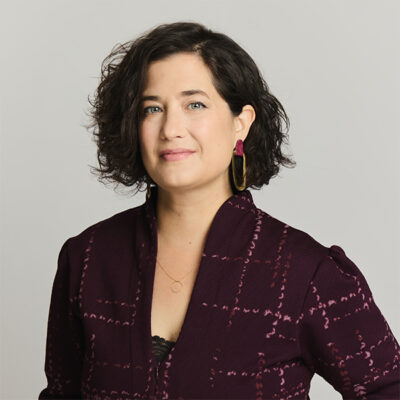
Naama Blonder
Architect & Urban Planner, Co-Founder, Smart Density
Year: 2024
Milestones in a career and life are a wonderful way of inspiring our emerging young leaders. Please share a proud or “magic moment” that shaped your journey?
One defining moment in my journey was when Toronto Life featured my family’s decision to live in a mid-rise apartment in downtown Toronto with two children and no car, in an article titled “Urbs vs. Burbs: My parks are nicer than your backyards.”
What made that moment meaningful was not just the publicity itself, but what it represented: an urban lifestyle I had been advocating for professionally suddenly became part of a much broader public conversation. It showed me that ideas about affordability, family life, and sustainable city-building could resonate far beyond the planning and design world. Since then, I’ve had the opportunity to speak across Canada, and one of the most rewarding parts of that journey has been seeing ideas I was once told were too niche or too ambitious become increasingly mainstream.
Who were your major influencers/mentors and what were the key lessons you gained from them?
There is a book my mum gave my daughter that I often read with her, and it inspires me every time. It is called Good Night Stories for Rebel Girls: 100 Tales of Extraordinary Women. Reading about the achievements, struggles, and persistence of so many remarkable women from different places and moments in history reminds me to stay committed to my own path.
What do you think are the next big challenges we need to tackle as an industry and as a successful city-region? Are there specific things you think we should be doing to meet the challenges?
We are still struggling to build enough housing in the kinds of places people actually want to live. The challenge is not only supply. It is whether we can create neighbourhoods that are more affordable, more complete, and better designed at the same time. Too often, we treat these goals as if they are in conflict.
They are not.
I believe the opportunity ahead is to shape growth more thoughtfully through better streets, blocks, buildings, and public spaces, and to communicate that vision in a way the public can clearly understand. When people can see what is possible, it becomes much easier to build support for the kind of change our cities need.
Tell us how you champion others in the industry.
I try to champion others by sharing what I know and making space where I can. I have benefited a lot from people who were generous with their time, advice, and encouragement, and I try to do the same for others. That has included supporting students, newcomers, and internationally trained professionals, hosting meetups and webinars, and sharing ideas through writing and public speaking. I do not see this as something separate from my work. I think we all have a responsibility to help make the industry a little more open and a little easier to navigate for the people coming into it.
What is your secret talent no one knows you have?
I am not sure how secret it is, but I am very good at simplifying complex things. I enjoy taking things that seem technical, abstract, or overwhelming and translating them into something clear and easy to understand. I tend to find the clear thread that helps other people make sense of it too.
What is the best word to describe you? And Why?
Bold is probably the best word to describe me. I have never been afraid to question the status quo or speak plainly when something is not working. Much of what I have advocated for over the years in housing, urban design, and city-building was not always popular or widely accepted. I kept going anyway. For me, boldness is not about being loud. It is about having the courage to stay clear, honest, and persistent about the future you want to build.